



We used to think diesel was cheaper, but after going to the filling station we found that diesel is not much cheaper than gasoline. The reason heavy trucks mostly use diesel engines must be that diesel has some special appeal. In fact, that appeal is that diesel engines are much more fuel-efficient than gasoline engines, generally by more than 20%. Although diesel and gasoline cost about the same, diesel can do more than 20% more work.
The fundamental reason heavy trucks widely use diesel engines is to reduce operating costs. Why does such a difference exist? What exactly is the difference between gasoline and diesel engines? Passenger car owners are often told to replace spark plugs during major maintenance. Spark plugs are a hallmark of gasoline engines; diesel engines do not use them.
The function of a spark plug is ignition. Each time the piston in the cylinder performs work, after compressing the air and gasoline, the spark plug fires at the proper moment. The flame then spreads from the spark plug through the cylinder, and the gasoline-air mixture burns, pushing the piston to do work. This is how a gasoline vehicle generates power.
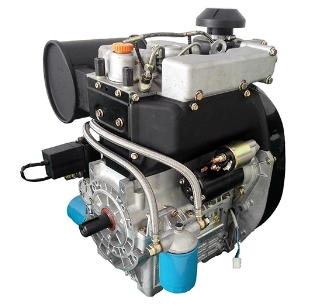
So how does a diesel engine ignite without a spark plug? Very simple: it relies on compressing the diesel-air mixture until the diesel reaches its auto-ignition point, at which point it ignites on its own. That is why diesel engines generally have a higher compression ratio than gasoline engines, and their combustion efficiency is also higher. At this point, not only you but even I might feel a little puzzled: gasoline is clearly easier to burn, so why doesn't it use compression ignition and instead still rely on a spark plug? Isn't that unnecessary? In fact, it is not.
This involves the issue of auto-ignition temperature. Based on the data, both the auto-ignition temperature and ignition point of diesel are actually lower than those of gasoline, so diesel is more likely to self-ignite and is therefore better suited to compression ignition. But this leads to a new question: if both the ignition point and auto-ignition temperature of diesel are lower than gasoline, why is diesel harder to ignite in daily life while gasoline is so easy to ignite? Doesn't that contradict the data? Actually, it does not. This relates to volatility. Gasoline evaporates very easily when unsealed, which leads to a very low flash point.
The term flash point may not be very familiar. Simply put, it is the lowest temperature at which a combustible liquid can ignite. The flash point of gasoline is only 28 degrees Celsius, so even a small flame can ignite it easily. But without an external ignition source, gasoline must reach 510 degrees Celsius to auto-ignite. By comparison, diesel at 350 degrees Celsius is relatively easier to ignite through compression ignition. Gasoline is therefore better suited to ignition by an external ignition source such as a spark plug, while diesel also has a higher energy density than gasoline. Combined with its higher compression ratio, this gives diesel engines higher combustion efficiency.
But why do diesel engines have such high torque yet relatively low horsepower? Because diesel engines have a higher compression ratio, their cylinder blocks are actually longer than those of gasoline engines, which allows the piston connecting rods to be made longer. The crankshaft can also be made longer. It is like using a one-meter-long wrench to tighten a bolt or riding a bicycle with one-meter cranks: the crankshaft torque will naturally be very large. Although the torque increases, the working range of the crankshaft and connecting rods also becomes larger, and their operating frequency is not as high as that of shorter components. As a result, diesel engines have relatively lower power, or horsepower. They are strong and suitable for heavy-duty work, but not especially fast.
A diesel engine is like an elephant hauling cargo: it pulls a lot each time, but it moves slowly. A gasoline engine is like a horse pulling a cart: it does not pull as much each time, but it moves very fast. As for why diesel engines are noisier, that is easier to explain: their piston stroke is longer, so vibration is naturally greater than in gasoline engines. However, with today's engine manufacturing technology, it is already difficult to tell the difference from inside high-end vehicles.


Add: Zhaiqiao Industrial Cluster,Qianhuang Town,Wujin District,Changzhou City,Jiangsu Province,China
Tel/Fax: +86-0519-85188296
Phone: +86-13801500234 / +86-13961492147
Postcode: 213172
Email: info@kyhon.com